GEOTECHNICALENGINEERING1
FORT LAUDERDALE
HomeIn-Situ TestingField density test (sand cone method)

Field Density Testing – Sand Cone Method in Fort Lauderdale

Site investigations you can build on.

LEARN MORE

ASTM D1556 remains the definitive standard for verifying compaction in the field, and in Fort Lauderdale where high groundwater and layered sandy fills dominate the subsurface, getting those density numbers right is not optional. The sand cone method provides a direct measurement of in-place density that no nuclear gauge can match when you are dealing with variable coastal deposits and limestone float at shallow depth. We run these tests routinely on commercial pads along Broward Boulevard, residential backfill in Victoria Park, and FDOT-spec subgrade beneath asphalt in the western expansion zones. Because Fort Lauderdale sits barely 9 feet above sea level on average, even a 5 percent under-compaction in a structural fill can invite differential settlement within the first wet season. Our laboratory runs the full cycle: calibrated Ottawa sand, field moisture samples sealed immediately, and density calculations cross-checked against the same Proctor curves that define your specification target.

If the sand cone test says 92 percent and the spec requires 95, no amount of wishful thinking will change what the plate load test reveals six months later.
Our service areas

Process and scope

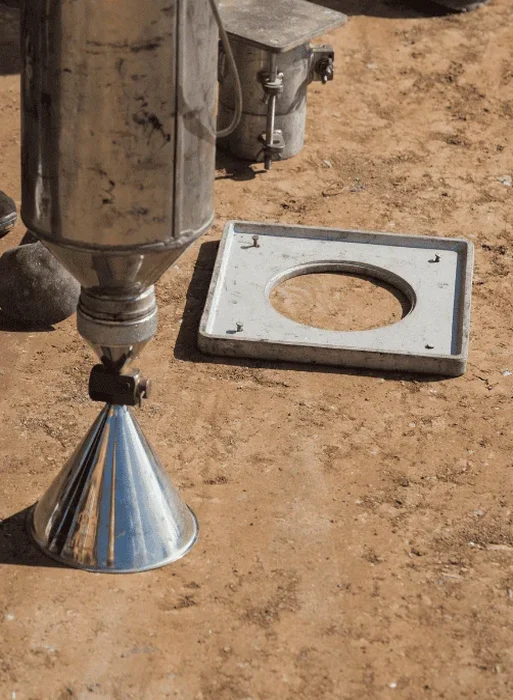
The field kit itself is straightforward but unforgiving if shortcuts are taken. We use a 6.5-inch base plate seated on a leveled test surface, a one-gallon sand jar with cone valve, and graded Ottawa sand that we re-calibrate against our lab standard every 20 tests. In Fort Lauderdale's summer humidity, the bulk density of the calibration sand can drift if the jar is not kept sealed, so our crew carries desiccated containers and checks the sand weight before every test series. Once the test hole is excavated through the compacted lift—typically 4 to 6 inches deep depending on spec—the excavated soil goes straight into a tared bag for moisture determination. The volume of the hole is measured by the weight of sand required to fill it, and the wet density converts to dry density using the moisture content from a parallel Speedy moisture test or lab oven. This procedure works reliably in the silty sands common along the New River corridor, though we adjust the hole depth when encountering shell fragments or coral rock fragments that can skew the volume measurement.
Field Density Testing – Sand Cone Method in Fort Lauderdale
Technical reference — Fort Lauderdale

Local considerations

A mid-rise parking garage going up near Las Olas had the subgrade signed off on a Friday, and by Monday morning the bottom of the excavation was ponding two inches of water. The fill had been placed in loose lifts during a dry week, and the contractor assumed visual observation was enough to skip density testing on the final lift. Once the rainy season hit, the saturated subgrade lost bearing capacity under the mat foundation, and the resulting slab cracking required extensive epoxy injection before the structure could open. Fort Lauderdale's water table sits less than 4 feet below grade in many neighborhoods—Edgewood, River Oaks, Shady Banks—so fill that tests at 98 percent compaction in the dry season can drop to 93 percent after saturation if the material contains enough fines. A sand cone field density test run before and after a controlled saturation event gives you a number you can actually defend to the structural engineer. Without that data, the assumption is always that the fill is fine, right up until the moment it is not.

Need a geotechnical assessment?

Reply within 24h.

Email: contact@geotechnicalengineering1.sbs

Applicable standards

ASTM D1556-15e1 – Standard Test Method for Density and Unit Weight of Soil in Place by the Sand-Cone Method, ASTM D698-12 – Standard Test Methods for Laboratory Compaction Characteristics of Soil Using Standard Effort, AASHTO T 191 – Standard Method of Test for Density of Soil In-Place by the Sand-Cone Method, FDOT Standard Specifications for Road and Bridge Construction, Section 120 – Embankment

Typical values

ParameterTypical value
Test standardASTM D1556 / AASHTO T 191
Calibration sandGraded Ottawa sand, bulk density checked every 20 tests
Typical test depth4 to 8 inches (single lift thickness)
Moisture determinationField oven or Speedy moisture tester, reported with each density value
Minimum test frequency1 per 1,500 sq ft per lift or per spec
Reporting unitspcf (lb/ft³) dry density and percent compaction vs. Proctor maximum
Applicable fill typesStructural fill, pipe bedding, trench backfill, pavement subgrade
Common Fort Lauderdale soils testedSilty sands (SM), poorly graded sands (SP), sandy clays (SC), crushed limestone base

Common questions

What is the typical cost for a sand cone density test in Fort Lauderdale?
When is the sand cone method preferred over a nuclear density gauge in South Florida?

The sand cone method is preferred when testing fills containing coral rock fragments, shell layers, or high organic content because these materials can skew the readings of a nuclear gauge. It is also the go-to method when the project specification explicitly requires ASTM D1556, which is common on FDOT projects and on sites where nuclear gauge licensing and radiation safety logistics become a constraint.

How long does it take to get results from a field density test?

The field portion of the test takes about 20 minutes per location, and we can provide the dry density and percent compaction verbally to the site superintendent immediately after the moisture determination is complete. A signed PDF report with the test location marked on the project plan, the calibration data, and the compaction curve overlay is typically delivered within 24 hours.

Location and service area

We serve projects across Fort Lauderdale and surrounding areas.

View larger map