GEOTECHNICALENGINEERING1
FORT LAUDERDALE
HomeLaboratoryGrain size analysis (sieve + hydrometer)

Grain Size Analysis (Sieve + Hydrometer) in Fort Lauderdale

Site investigations you can build on.

LEARN MORE

Along the barrier island and canal frontages of Fort Lauderdale, near-surface soils often carry a fine carbonate sand fraction that doesn't show up clearly in a standard sieve stack. We have seen this repeatedly in the Las Olas Isles and Rio Vista neighborhoods, where a hydrometer extension becomes essential for accurate classification. A grain size analysis performed only to the No. 200 sieve misses the silt and clay curve that controls drainage behavior in flat, high-water-table sites. Our lab runs the full ASTM D422/D6913 combined method, giving Fort Lauderdale engineers a single particle-size distribution from coarse sand down to the clay fraction. This data feeds directly into USCS classification per ASTM D2487, compaction specification checks, and seepage assessments. For deep foundation projects near the Intracoastal, where SPT drilling samples encounter interbedded silty layers, the hydrometer tail often reveals a gap-graded fabric that influences pile skin friction assumptions. The combined sieve-plus-hydrometer report typically ships in three to four business days.

A complete grain size curve down to the clay fraction is the difference between a borderline SW-SM classification and a properly identified SC material that will behave very differently under Fort Lauderdale's high water table.
Our service areas

Process and scope

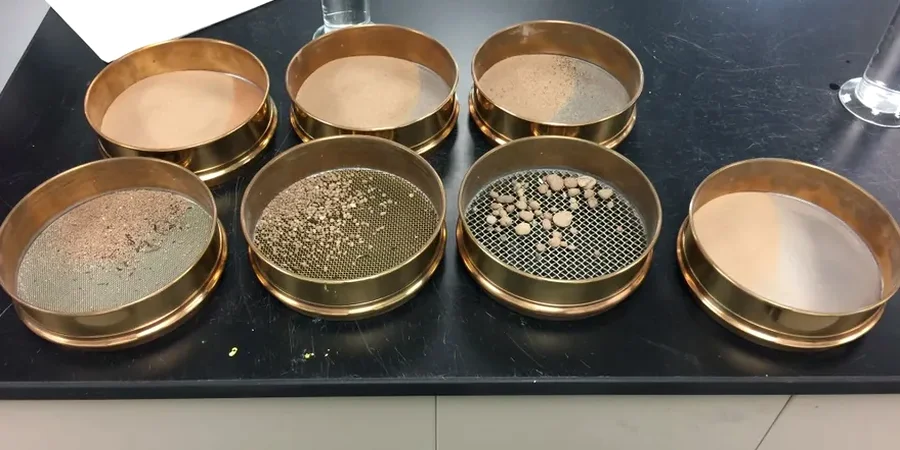
A recent mid-rise residential job on Southeast 17th Street illustrates the local challenge. The geotechnical boring recovered a tan fine sand with shell fragments that visually appeared clean, but the full grain size analysis showed 14 percent passing the No. 200 sieve, predominantly low-plasticity silt. That changed the drainage layer specification and triggered a Proctor test to verify achievable density under the new moisture sensitivity. Our laboratory procedure for Fort Lauderdale samples starts with an oven-dried split, then a wash over the No. 200 sieve to separate fines. The retained fraction goes through a full nest of ASTM E11 sieves on a mechanical shaker, while the minus-200 material runs through a sedimentation hydrometer test with sodium hexametaphosphate dispersant. The combined curve gets plotted on a semi-log chart with grain diameter on the x-axis and percent passing on the y-axis. Key output parameters include D10, D30, D60, coefficient of uniformity (Cu), coefficient of curvature (Cc), and the gravel-sand-silt-clay percentages. When the fines content exceeds 12 percent and the project sits within Fort Lauderdale's shallow groundwater zone, we often recommend pairing grain size with Atterberg limits to resolve the Casagrande plasticity chart classification. The data package includes the plotted curve, tabulated results, and a brief interpretive note on the USCS group symbol.
Grain Size Analysis (Sieve + Hydrometer) in Fort Lauderdale
Technical reference — Fort Lauderdale

Local considerations

ASTM D2487 classification rules in Section 17 of the standard are clear: a dual-symbol borderline soil must be placed in the more conservative group for engineering design. In Fort Lauderdale, where the seasonal wet season raises the surficial aquifer to within two feet of grade, misclassifying a silty sand as a clean sand has direct consequences on pavement subdrainage design and retaining wall backfill specification. We have seen projects on the western edge near the Turnpike where a grain size analysis run only to the No. 200 sieve classified the material as SP, but the hydrometer extension revealed 16 percent clay, shifting the group symbol to SC. That reclassification changed the recommended permeability by an order of magnitude and required a redesigned underdrain system. The combined sieve-and-hydrometer method eliminates this blind spot. The data also feeds into liquefaction screening per Seed and Idriss procedures, where the fines content correction factor directly modifies the cyclic resistance ratio. For any Fort Lauderdale project where a geotechnical report will be submitted to the city's Building Department under the current Florida Building Code and IBC, omitting the hydrometer when fines are visually present can lead to plan review comments and construction-phase change orders.

Need a geotechnical assessment?

Reply within 24h.

Email: contact@geotechnicalengineering1.sbs

Applicable standards

ASTM D422-63(2007)e2 – Standard Test Method for Particle-Size Analysis of Soils (hydrometer method), ASTM D6913/D6913M-17 – Standard Test Methods for Particle-Size Distribution (Gradation) of Soils Using Sieve Analysis, ASTM D2487-17e1 – Standard Practice for Classification of Soils for Engineering Purposes (Unified Soil Classification System)

Typical values

ParameterTypical value
Test standardASTM D422 / D6913 (combined sieve + hydrometer)
Sieve range3 in to No. 200 (75 mm to 0.075 mm)
Hydrometer range0.075 mm to approx. 0.001 mm (clay fraction)
DispersantSodium hexametaphosphate (40 g/L solution)
Key coefficientsD10, D30, D60, Cu, Cc
Classification systemUSCS per ASTM D2487, AASHTO M 145
Typical report turnaround3 to 4 business days for Fort Lauderdale samples

Common questions

What is the cost of a grain size analysis with sieve and hydrometer in Fort Lauderdale?
How long does a full sieve-plus-hydrometer test take?

Standard turnaround is three to four business days from sample receipt. The hydrometer sedimentation phase alone requires a minimum 24-hour reading series, so rush requests can bring it down to two days with an expedited surcharge.

What sample mass do you need for the combined test?

We typically request a minimum of 500 grams of dry material for a combined sieve and hydrometer analysis on sands and silty sands. For gravelly soils, increase the mass proportionally based on the maximum particle size—roughly 2 kg for material with 3/4-inch gravel. Samples should be sealed in airtight bags immediately after field collection to preserve natural moisture.

Why is the hydrometer part necessary if the soil looks clean?

Visual classification is unreliable for the silt and clay fraction. In Fort Lauderdale's coastal plain geology, sands that appear clean often carry 8 to 15 percent non-plastic silt that significantly affects permeability, frost-susceptibility classification, and seismic liquefaction screening. The hydrometer quantifies that fraction and provides the data needed for a correct USCS group symbol.

Location and service area

We serve projects across Fort Lauderdale and surrounding areas.

View larger map